
Role: Founding Designer & Lead Product Designer
Company: Zerofy, climate-tech for households, later pivoted to energy
Scope: Prototype to launched product, new connected services, and every touchpoint experience, including social media until marketing was hired
Team: 4, growing to 7 in my time
When 2022–2023
Result: 32 prototype testers to 500 MAU, onboarding conversion from 0% to around 18%, a solar service that became the company's first revenue, and a communication system that still runs the product today
THE MOMENT
Zerofy set out to decarbonise households. The premise was sound: around 70% of global emissions can be traced back to what happens in homes, and the ambition was to give people real-time insight into their footprint and a way to act on it.
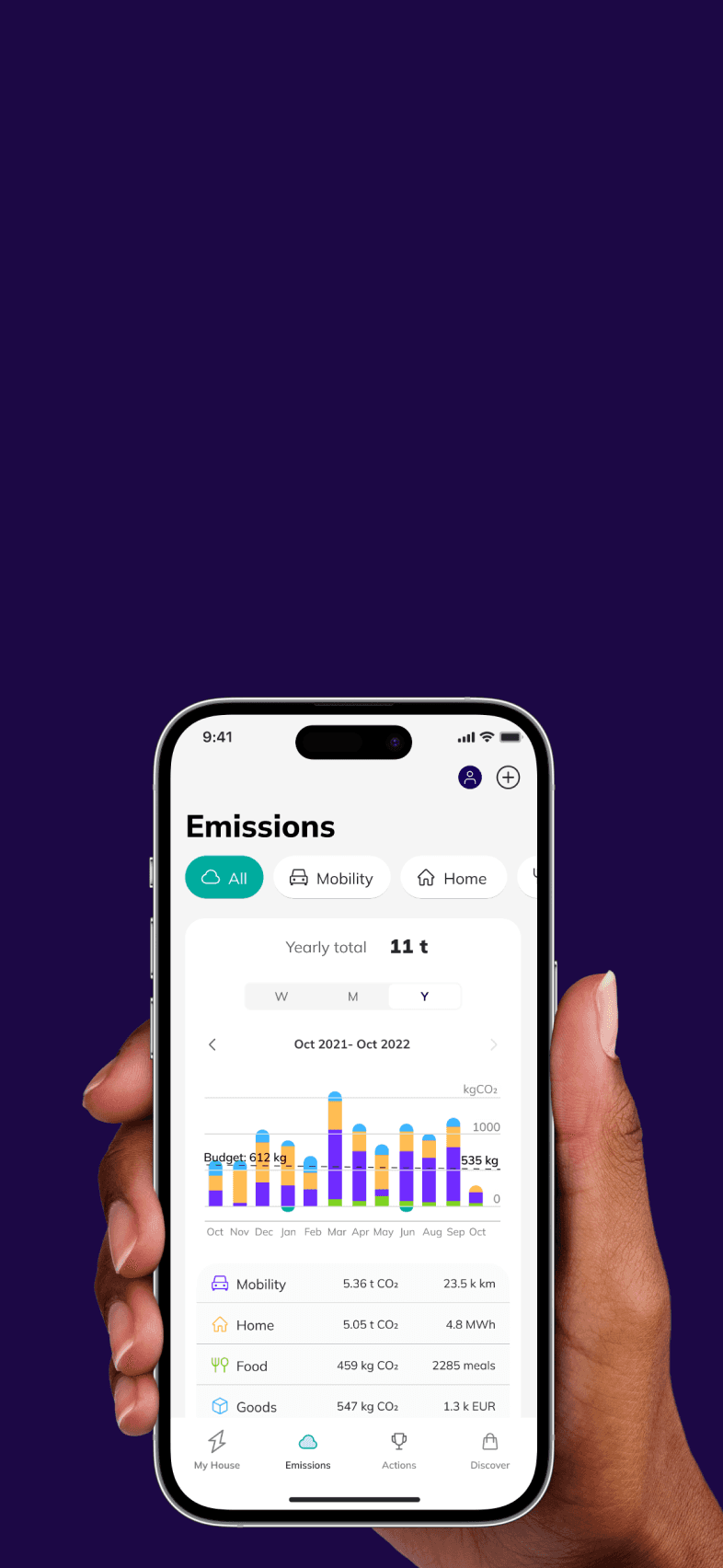
I arrived at the prototype stage: an iOS build a freelancer had designed in a short project, with 32 test users. The first thing I did was unglamorous, the App Store screenshots were unattractive, so I fixed them, because that's the shop window nobody had cleaned. From there I audited the whole experience end to end from discovery channels, website, appstore, app experience and offbording, and ran usability testing focused on the two moments that matter most: the "that's annoying" and the "WTF happened there." That's where the friction lives.
The audit was blunt. On the app itself, people couldn't tell what a kilogram of CO₂ actually meant, or whether their actions were making a difference. Onboarding had five long steps and created friction before anyone reached the value. Forms lacked feedback and context. The dashboard drew a flat "I don't understand what I'm seeing here." None of it was fatal, but all of it added up to the same thing: a product asking people to change their lives before it had earned a minute of their attention.
And underneath the usability problem was a harder one we couldn't yet name. We were proving a thesis: that people would reorganise their household to decarbonise, and the market wasn't answering the way the thesis needed it to.
THE BET
The first bet was the obvious one: make the thing usable. Give the numbers meaning, give actions feedback, and get people to value before asking them for everything. Onboarding was the sharpest example, the backend demanded every section be filled in so it could automate measuring in the core experience, which is why the flow was so heavy. I redesigned it, then kept simplifying: empty states, deferred inputs, less asked for upfront. I redesigned the main features and navigation throughout, and watched two signals in parallel, the analytics for what people actually used and the impact it had, customer interviews for whether it was usable and whether new features were wanted.
It worked, and it wasn't enough. The improvements won users, not a leap. Polishing a decarbonisation app made it better; it didn't make it wanted.
The real bet came out of the research. Four to five months in, one insight cut through: renters can't decarbonise their energy source. They don't own the roof, they can't change the supply, and the product had nothing for them. That opened a service the app couldn't: rent a solar panel. We tested it before betting the company on it , the CFO, an energy engineer, built a 150-panel plant in Estonia; the CEO and I built the service around it, the contract, the experience, the monitoring, ready for dev to implement. It didn't take long for Zerofy to earn its first revenue. Small, but a real signal, the first time the market paid rather than nodded.
Then the 2023 energy crisis landed, and the fog cleared. Energy was the biggest lever for decarbonisation, and the one people suddenly cared about with their wallets. That reframed the whole company: from decarbonisation-in-general to energy, the throughline Zerofy still runs on today.
WHAT I SHAPED
The offering, through UX research and together with the CEO and CFO, the renter insight became the solar service, and the reframing toward energy that followed the crisis.
The product experience, together with the CEO, developers, and the data scientists once they joined. The redesigned onboarding, features, and navigation, validated with analytics and interviews rather than opinion. As well as in product feedback collection mechanism.
The figma setup, comms systems and the workflows around it, connecting design, dev, and product. It earned its keep when we moved off iOS-only and rebuilt in React Native. A shift that was partly about reaching a bigger market, and because the system was ready, I redesigned the whole app in a week and a half rather than starting over.
The touchpoints, the website design, messaging and structure, print for events, and the illustration and communication language that gave everything one voice.
THE EVIDENCE
A few things I can count:
32 prototype testers → Around 500 monthly active users.
Onboarding conversion from 0% to 18%, once it stopped asking for everything upfront.
A working solar panel rented service, the service that became the company's first revenue line.
A design, illustration, and communication system that still lives in the product today.
And one thing I can point to rather than count: Zerofy earned outside validation, including a Fast Company feature in January 2023 that singled out the low-friction approach and the shared solar farm for renters.
The clearest evidence is the company itself. The energy pivot wasn't a detour, it was the start of the direction Zerofy still runs on. Reaching for a bigger market was already part of the thinking then; it's one of the reasons we moved off iOS and rebuilt in React Native. That direction has since grown into what Zerofy is today: a B2B home-energy-management platform used by energy providers and installers like E.ON and Svea Solar. I didn't build that later chapter, and I won't claim it, but I was there when the bet was made. When the focus shifted to energy and the growth moved into data and backend, I helped hire the designer who'd carry the experience forward, and left to build a design organisation at Position Green.