

Role: Lead Service Designer & Growth Design Manager
Company: Joint Academy, digital-health physiotherapy for chronic joint pain
Scope :Turned a regulatory shift into a redesigned service, a validated self-care model, a growth loop connecting physical clinics to digital treatment, and the design foundations underneath it all while managing the growth design team.
Team: A cross organization collaboration + 4 designers, UX researchers and writers in the growth team.
When 2021–2022
Result A self-care offering that reached 20% conversion at launch, 20–25% gains in activation and retention, a strategy and experience model for a hybrid clinic, and foundational design processes the organisation kept
THE MOMENT
Joint Academy treats chronic joint pain through an app: a licensed physiotherapist, a personalised exercise programme, interactive lessons, and progress tracking, all clinically proven, delivered from home, across 4 geographic locations. In Sweden the model ran on public reimbursement, paid per care event, with consultations used as needed up to a limit.
Then that limit moved. The regional payer cut the number of reimbursed care events roughly in half. Overnight this wasn't a scheduling detail, it was a direct hit to revenue, patient improvements and, more a threat to the reimbursement model the whole Swedish business rested on. The old shape of the service assumed more billable touchpoints than the new rules allowed.
I'd joined just before those rules came to play, at a moment were the product organisation was being reshaped by a new CPO, from project teams into product teams organised around clear missions (patient, professional, growth, compliance, expansion). That change was healthy in the long run , but disorienting in the short term: teams that used to know their lane were suddenly storming. My first mission from the CPO was to improve design quality, that was until the regulatory shifts happen and my attention moved.
THE BET
In healthcare, revenue cuts aren't just a business problem, they're a clinical one. When new rules capped the reimbursed care at Joint Academy, we had to adapt without compromising the scientific outcomes and patient health the service was built on.
So we treated the challenge as a service design and innovation problem rather than a pure commercial one. That meant redesigning the care model, shifting from a fixed, therapist-led treatment to one where guided care transitions smoothly into continuous self-care, care that had to stay clinically effective and be valuable enough for patients to pay for, and designing for a future where care moves seamlessly between digital and physical spaces.
I introduced iterative discovery. Transitioning to a new business model is inherently risky, so rather than building blindly we relied on continuous discovery, forming hypotheses and validating assumptions early. That structured approach de-risked the new model, giving us the confidence that we needed before scaling it in production.
WHAT I SHAPED
1. Design quality
Handed "improve design quality," I reframed it from a polish task into a shared one: how might we improve design processes and overall design quality? The reframe mattered because quality at Joint Academy was never design's alone to give, it lived across product, engineering, operations, marketing and clinical, and raising it meant changing how those roles worked together, not just how screens where experienced.
So I built foundations rather than fixes. A shared definition of what "good" meant, held against co-created experience principles any team could actually decide with. An accountability framework and clearer communication structures, so the storming had rails. Design "chapters" to grow craft across product teams, a move toward a coded design system to cut repetitive visual QA, service blueprints to make the whole experience legible, and early metrics to even see where design quality stood. It was deliberately a "living" effort, documented as it grew, and when the regulatory work arrived, my focus shifted, But the foundation was what let them move quickly when they did.

2. The self-care offering. de-risked, not gambled
When reimbursed care was capped, a cross-functional task force formed to answer it. A PM, the Head of Operations for Sweden, and me, reporting to executive leadership. I led its initial strategy phase, until it took shape and Product and Operations carried it forward. My focus was system-level: finding where a self-paid tier could fit naturally within the treatment without breaking patient trust or clinical outcomes.
To de-risk the new value proposition and find real evidence for it, I ran a three-stage validation loop:
Quantifying demand. A survey of recent treatment graduates to validate patient interest and test willingness to pay.
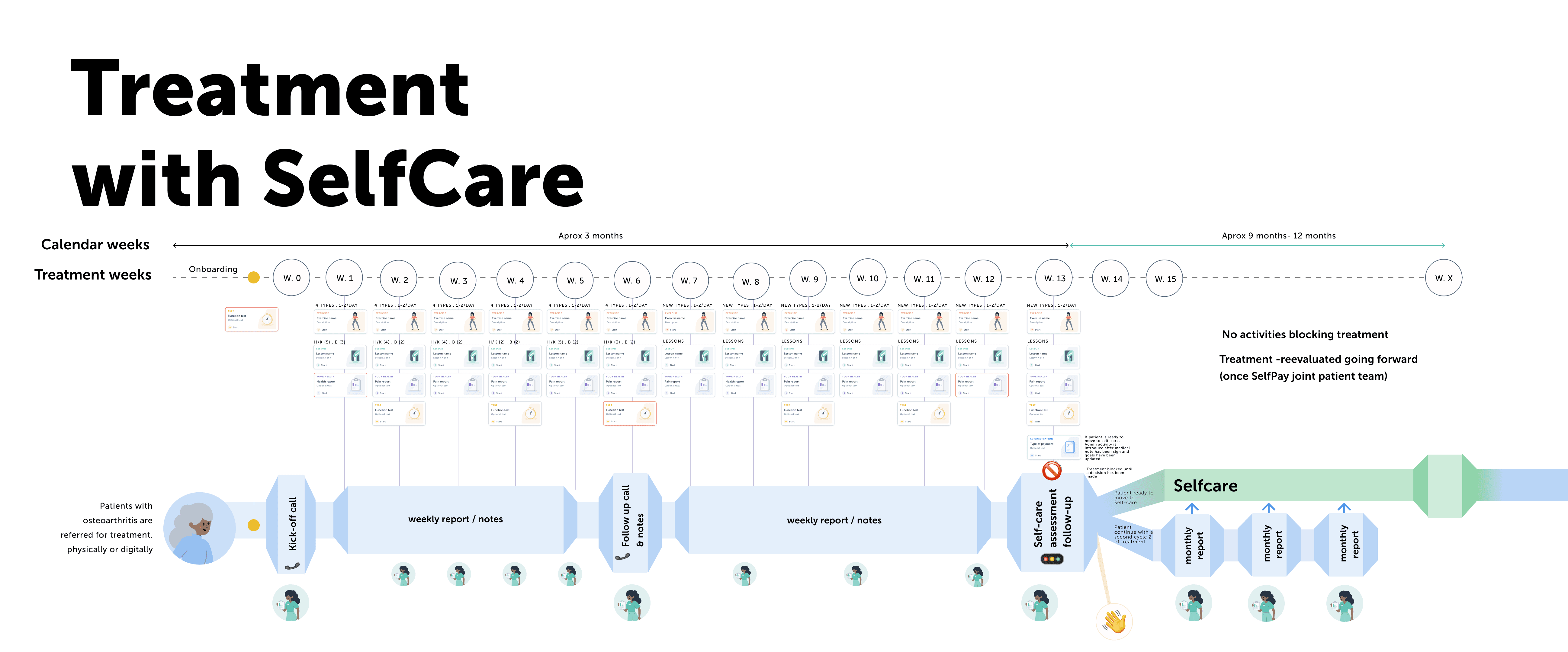
Wizard-of-Oz MVP. We simulated the end-to-end service by hand, using the existing clinical and operational teams to run the email and in-app communication, a check-up, and the hand-off to self-managed care. This help us validate conversion, the scripts for the human interactions, and the hand-off mechanics with zero engineering overhead.
Scaling in code, ops and clinical. Only once the mechanics were proven did we ship a native, feature-flagged product experience with integrated payments, operations training rolled out across the physiotherapist body, and the clinical team fully supporting the new shape of the treatment.
What emerged was Self-care. The treatment shifted from a pure care model to a treatment-plus-continuous-self-care model, with a supported option to transition at the point reimbursed care ended and patient outcomes were in a place to continue alone without clinical support. It reached 20% conversion at launch. The signal that patients would pay to keep going when the hand-off was designed as a natural progression of care rather than presented as a paywall.
3. The clinic experience
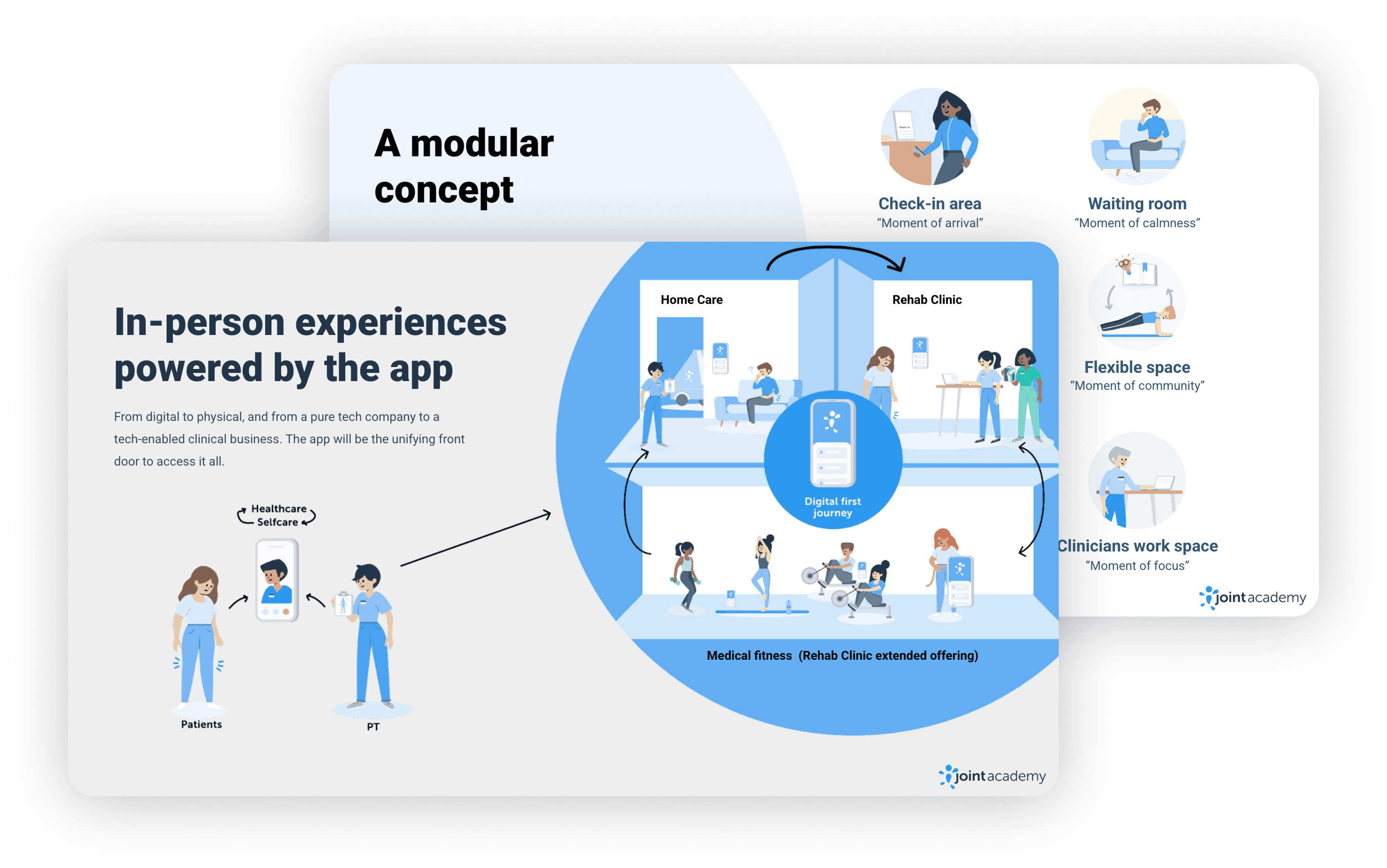
The long-term vulnerability was structural: reliance on a single reimbursement source. Working alongside leadership and operations, we explored a hybrid offering that brought in home and physical clinics into Joint Academy digital experience.
I anchored the strategy around two questions: how do we create a seamless omnichannel care experience, and what makes a physical space distinctly Joint Academy?
Ecosystem redesign and growth loop. I proposed a shift from a single-protocol, single-therapist digital journey to a collaborative, multi-specialty care-team model, embedding continuous self-care throughout the patient journey. Allowing a loop between clinics, app and home.
Mapping and prototyping. I mapped all journeys across app, clinic, and home, and established hypothesis-testing frameworks to de-risk key assumptions around patient adherence and omnichannel desirability.
Modular spatial design. The design team created the moodboards meanwhile I focus on the experience a "building-blocks" of physical concept: warm, social, non-clinical spaces that could adapt to any footprint, from small pop-ups to flagship facilities.
Rather than trying to build the full horizon-three vision at once, we scoped it down to high-leverage MVPs to validate early.
Underneath all three, I helped establish the design foundations the organisation kept : processes, the move to a design system, discovery frameworks, and product and service principles, and worked with the Head of Design on how the design organisation itself should be structured.
THE EVIDENCE
My impact showed up in two ways: immediate product metrics and a longer-term strategic shift.
Immediate and measured outcomes
Sustained self-care monetisation. The self-care offering launched at 20% conversion and proved its long-term viability, evolving into its own dedicated product team.
Growth and retention optimisation. I led a cross-functional design team (two designers, a UX researcher, a UX writer), driving 20–25% improvements in patient activation and retention. Beyond the numbers, my focus was supporting the team, keeping morale high, and championing ethical standards during difficult pivots.
Support scalable design operations. I established foundational principles, discovery frameworks, and design-system standards that outlasted individual projects.
Long-term strategic impact
Validating the hybrid care model. Success on the hybrid clinic vision wasn't measured in immediate changes, but in strategic alignment and de-risking a fragile reimbursement model. By mapping critical assumptions, prototyping spatial experiences, and scoping phased MVPs, we gave leadership a validated path forward.
Enduring impact. Almost 2 years after I left, Joint Academy opened its first physical clinic, built on the strategic foundation established during this work.